
Why Choosing the Right SEO Partner Matters
Search visibility shapes how customers find your business long before they ever call or visit. When your site appears on page one for the searches that matter to you, you get steady inquiries. When it doesn’t, you spend more on ads just to stay visible.
Choosing an SEO partner is a decision with real consequences. The right agency builds a foundation that compounds over months and years. The wrong one can leave you with keyword reports, tidy-looking dashboards, and little change in leads.
Before you compare providers, consider a few questions:
- What does success look like for your business in the next six to twelve months?
- Which customers do you want more of: local buyers, regional clients, or national audiences?
- Do you need help with rankings alone, or also with your website, reviews, and social presence?
Clear answers make it far easier to judge whether a proposal fits your goals.
The Challenge of Generic SEO Packages
Many agencies sell fixed monthly packages with names like “Starter,” “Growth,” or “Premium.” Each tier bundles a set number of keywords, blog posts, and citations. On paper, this looks efficient and easy to budget.
The problem is that search results depend heavily on context. A plumber in a mid-sized city, a boutique software firm, and a regional furniture retailer face very different competitors and customer questions. A package built for one rarely fits the others.
Common signs of a generic approach include:
- The same keyword list is used across unrelated industries.
- Reporting focuses on activity, such as number of posts published, rather than leads or calls.
- The proposal never asks about your sales process, pricing, or service area.
If a provider can’t explain why its plan suits your specific market, treat that as a warning sign.
What Customized SEO Really Means

Customized SEO starts with your business rather than a template. It means researching your competitors, understanding how your customers search, and identifying the pages and offers that can win them. The strategy then gets adjusted as results come in.
In practice, customization usually covers:
- Audience and intent: Who you serve and what they type when they’re ready to buy.
- Competitive position: Which rivals already rank and where gaps remain.
- Site condition: Whether your pages, structure, and speed support rankings.
- Local factors: Service areas, Google Business Profile quality, and location-specific content.
If your team can name these elements in a proposal, you’re likely looking at a tailored plan.
How Our Customized SEO Approach Works
We begin with a discovery phase that reviews your website, analytics, current rankings, and the search terms that already bring visitors. We also talk with you about your best-margin services, your busiest seasons, and the customers you want to attract more of.
From there, we build a plan in four stages:
- Audit: We identify technical issues, content gaps, and conversion barriers.
- Prioritize: We rank fixes by likely impact on leads, not by how many tasks they generate.
- Execute: We implement changes in batches so you can see what’s working.
- Review: We check results monthly and shift effort toward whatever is producing revenue.
For example, a home services company might discover that its service pages are thin while its blog gets traffic that never converts. Our fix would be to strengthen the service pages first, then connect informational posts to them with clear calls to action.
Keyword Research and On-Page Optimization We Deliver
Keyword research tells you what people search for, but the real value comes from matching those searches to buying intent. A term like “emergency roof repair near me” signals urgency, while “how do roofs last” signals early research. Each needs a different page and message.
Our keyword work typically includes:
- Mapping keywords to specific pages so two pages don’t compete for the same term.
- Prioritizing terms by search volume, competition, and likelihood to convert.
- Refreshing titles, headers, meta descriptions, and internal links for clarity.
- Adding supporting content where customers have questions your site doesn’t answer.
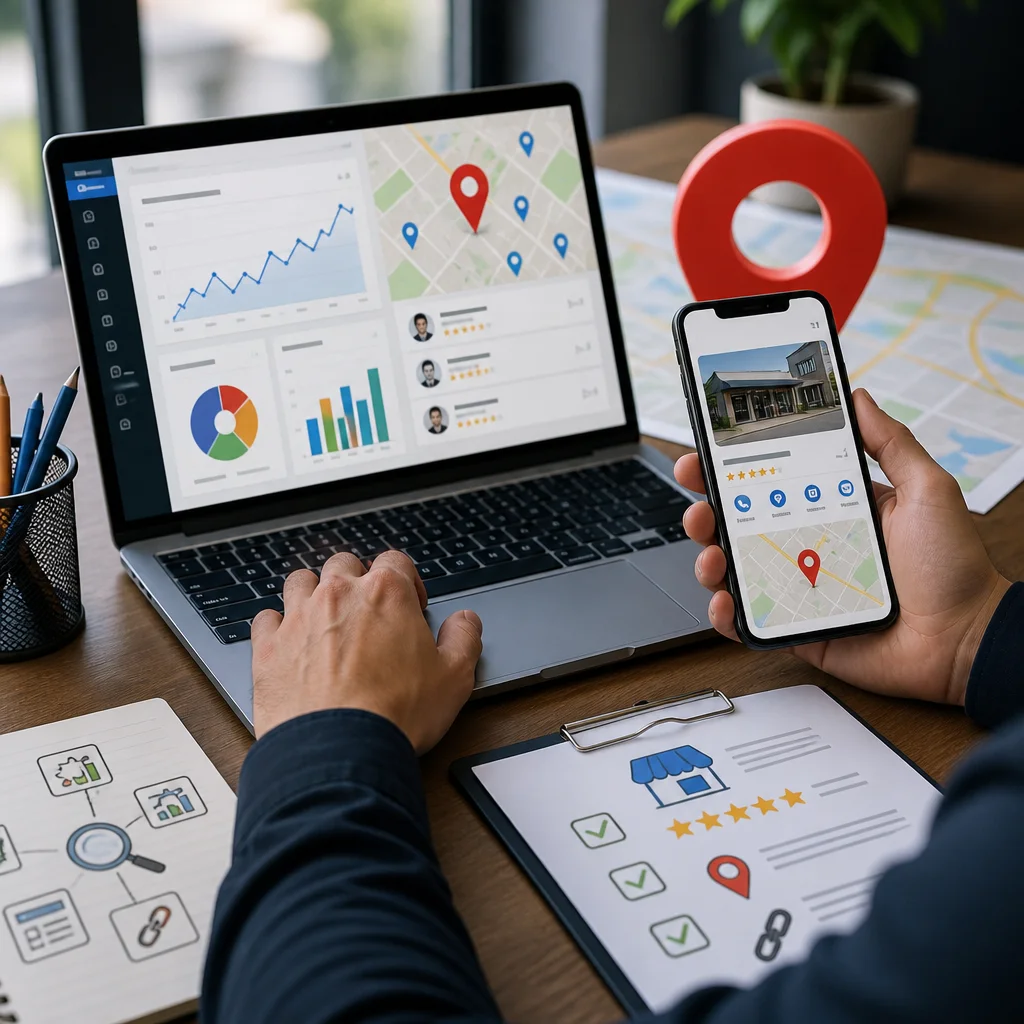
Action step: Pull the top ten pages on your site by organic traffic and ask whether each one clearly states the service, location, and next step. Pages that fail this check are usually the fastest wins.
Our SEO services cover this process from research through implementation.
Local SEO and Google Business Profile Optimization
For many businesses, local search drives the most valuable leads. Customers searching for a service “near me” or in a specific neighborhood often want to call or visit within the hour. Ranking in the local map results can matter as much as ranking on the main results page.
Local SEO work usually focuses on:
- A complete and accurate Google Business Profile, including categories, hours, services, and photos.
- Consistent name, address, and phone information across directories.
- Location pages that address real local needs rather than swapping in a city name.
- Review generation and timely, professional responses to feedback.
If you serve a specific metro area, a dedicated page can help. We support businesses in markets like Nashville through our local SEO services, where competition and neighborhood search patterns vary widely.
Technical SEO, Backlinks, and Content Growth
Technical SEO ensures search engines can crawl, understand, and index your site. Common issues include slow load times, broken links, duplicate pages, and missing structured data. Fixing these won’t guarantee rankings, but ignoring them can hold everything else back.
Backlinks remain an important trust signal. The best links come from relevant local organizations, industry publications, suppliers, and customers. Chasing large volumes of low-quality links usually creates risk without benefit.
Content growth ties these pieces together. We favor articles that answer real questions your customers ask during sales conversations. A contractor might publish a guide on permit timelines, which earns links from local government resources and brings in readers who are close to hiring.
Quick check: Ask your current or prospective provider how they decide which content to publish. If the answer is “keyword volume” alone, probe further.
Measuring Results and Long-Term Visibility

SEO results build gradually, so measurement needs a clear framework. Rankings matter, but they are a means to an end. The outcomes that count are qualified traffic, calls, form submissions, booked appointments, and revenue.
We report on a short list of metrics:
- Organic traffic to priority service pages.
- Rankings for target keywords, grouped by service and location.
- Google Business Profile actions, such as calls, direction requests, and website clicks.
- Lead volume and, where possible, close rate.
We also set expectations early. Many sites see meaningful movement within three to six months, while competitive markets can take longer. Consistent effort over time is what builds durable visibility.
Why Businesses Choose Top 3 SEO Company
Businesses choose us because we combine strategy with hands-on execution. We don’t stop at recommendations. Our team handles keyword research, on-page improvements, local listings, technical fixes, web design, review monitoring, and social media, so your search presence works together.
Clients typically value:
- Tailored plans: Each strategy reflects your market, services, and goals.
- Connected services: SEO, web design, and reputation management support one another.
- Transparent reporting: You see what we’re doing and why it matters for leads.
- Local and broader reach: We help businesses compete in their home market and beyond.
If you’re comparing us with other providers, ask each one how it would customize a plan for your business. The answer will reveal more than any package price.
Next Steps to Grow Your Online Visibility
Start with a simple self-assessment:
- List your three most profitable services and the cities or areas you serve.
- Search for those services yourself and note which competitors appear.
- Check your Google Business Profile for completeness and recent reviews.
- Review your top service pages for clarity, proof, and a clear call to action.
Once you know where you stand, bring those notes to your SEO conversations. Strong providers will ask follow-up questions and propose a plan built around your priorities.
If you’d like help, we can run a custom audit of your site and local presence and outline the highest-impact opportunities. Reach out through Top 3 SEO Company to start the conversation.
