
Why Online Reviews Now Shape Local Search Rankings
Search engines have turned reviews into a ranking signal, and local searchers rely on them even more. When someone searches for a plumber, dentist, or coffee shop near them, they often scan star ratings and recent comments before they click anything. That means your review profile is doing sales work whether you actively manage it or not.
Reviews influence local rankings through several connected factors:
- Review quantity: A steady flow of reviews signals that a business is active and trusted.
- Review rating: Average star ratings affect how prominently a listing appears and how often people click it.
- Review recency: Fresh reviews tell both search engines and customers that the business is currently operating well.
- Review content: Keywords that customers naturally use in their feedback can reinforce relevance for local queries.
Next step: Pull your current review count, average rating, and the date of your most recent review for your primary location. Those three numbers give you a baseline for everything that follows.
The Hidden Costs of Unmanaged Customer Reviews
Many businesses treat reviews as something that happens to them. The cost of that passive approach rarely appears on a balance sheet, but it shows up in lost calls, missed bookings, and slower growth.
Consider a small home services company with a 4.6-star average. Its competitor sits at 4.9 with more recent feedback. Searchers may never see the first company’s listing in the top results, or they see it and choose the competitor after a quick comparison. Over a year, that gap can represent a meaningful share of new customers.
Unmanaged reviews also carry risks beyond rankings:
- Unanswered complaints signal indifference to prospects reading the page.
- Outdated negative reviews can linger and shape first impressions for months.
- Scattered platforms make it easy to miss a review on a secondary site until it has spread.
- Staff confusion leads to inconsistent or delayed responses.
Next step: Audit the last 90 days of reviews across every platform where your business appears. Count how many you have not responded to. That number is a practical measure of your current exposure.
How Reviews Influence Local Pack and Map Visibility
The local pack, the group of three map listings that appears for many local searches, is among the most valuable real estate in search. Reviews are one of the factors that help determine which businesses appear there, alongside relevance and distance. Reviews do not work alone, but they can tip the balance between two similar businesses.
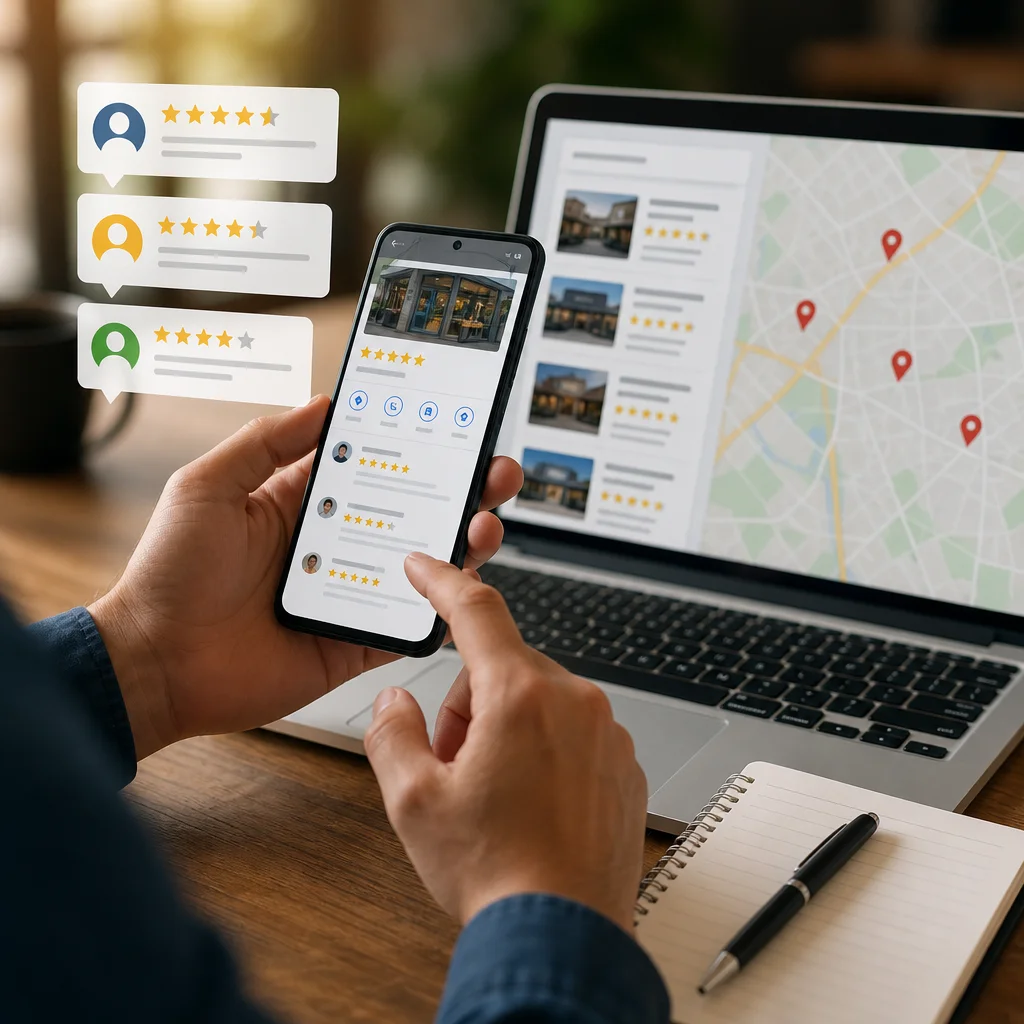
For example, two landscaping companies in the same neighborhood may both be relevant to a “lawn care near me” search. The one with more recent five-star reviews mentioning specific services such as aeration or mulch installation often earns the stronger position. Those details give search engines and customers clearer evidence of what the business actually does.
Map visibility also depends on how complete and active your listing looks. A profile with photos, correct hours, responses to reviews, and consistent contact details gives searchers more reasons to choose you.
Next step: Search for your top three service keywords in your service area and note which businesses appear in the local pack. Compare their review volume, recency, and response activity against yours.
Optimizing Your Google Business Profile for Reviews
Your Google Business Profile is the center of your review strategy. Every review you collect there affects your visibility in Google Search and Maps, so the profile itself needs to be set up to support that goal.
Start with the basics:
- Verify your listing and confirm your business name, address, phone number, and categories are accurate.
- Choose primary and secondary categories that match how customers describe your work.
- Add photos regularly, including your team, completed projects, and your location, since active profiles tend to earn more engagement.
- Use the review link from your profile dashboard so customers can leave feedback in one click.
Google’s policies prohibit incentivizing reviews, offering rewards for positive feedback, or filtering who gets asked. Ask every customer in the same way, and never pay for or write reviews on their behalf.
Next step: Log into your Google Business Profile and fill out every field you have skipped. Then generate a short review link and save it where your team can access it easily.
Building a Consistent Review Generation Process
Reviews rarely come from one-time requests. Businesses that earn steady feedback build a repeatable process so that asking becomes routine rather than awkward.
A practical process often includes these steps:
- Identify the right moment. Ask shortly after a successful job, delivery, or appointment, while the experience is fresh.
- Make it easy. Send a direct link by text or email rather than asking customers to search for your listing.
- Follow up once. A single reminder a few days later is usually enough. Repeated messages can frustrate people.
- Track who was asked. A simple spreadsheet or CRM field helps avoid duplicate requests and reveals which service lines generate the most feedback.
Train staff to ask naturally. A technician might say, “If you were happy with today’s visit, a quick review would help us a lot.” That phrasing invites honest feedback instead of pressuring a rating.

Next step: Write a two-sentence review request template and a follow-up message. Test them for 30 days and record how many customers respond.
Responding to Positive and Negative Reviews Effectively
Responses matter because future customers read them. A thoughtful reply shows that you listen, and it can turn a negative experience into evidence of good service.
For positive reviews, keep replies brief and specific. Thank the reviewer, mention a detail they included, and invite them back if it fits your business.
For negative reviews, follow a steady structure:
- Acknowledge the concern without arguing or repeating the complaint in harsh terms.
- Take the conversation offline by providing a direct contact method or staff name.
- Avoid sharing private details such as account information or medical history.
- Respond within a day or two when possible, since timely replies look more professional.
Here is an example of a clear response to a delayed appointment: “We are sorry your appointment started late on Tuesday. We know your time matters, and we are reviewing our scheduling to prevent this. Please call our office so we can make this right.”
Next step: Draft three response templates, one for praise, one for mild criticism, and one for serious complaints. Store them where your team can adapt them quickly.
Monitoring Reviews Across Platforms in One System
Reviews appear on Google, Facebook, industry directories, and niche sites. Checking each one manually wastes time and leads to missed feedback. A single monitoring system keeps your response process organized.
Effective monitoring usually includes:
- A central dashboard or shared spreadsheet that lists every new review, its platform, its rating, and its status.
- Clear ownership, so one person or role handles responses each week.
- Alerts for new reviews on your key platforms so urgent negative feedback gets attention quickly.
- A monthly review of themes, noting recurring praise or complaints that signal process improvements.
Consistency across platforms also protects your reputation. If your hours, address, or services differ between directories, search engines may question which information is accurate.
Next step: Choose a single tool or spreadsheet, list every platform where you are listed, and assign one person to check each one on a set schedule.

Connecting Review Strategy to Broader Local SEO Growth
Reviews support local SEO, but they work best alongside other improvements. Strong listings, relevant service pages, accurate citations, and helpful content all reinforce one another.
For instance, customer reviews often mention specific services, neighborhoods, or problems you solved. Those phrases can guide the content you publish on your website, such as service pages that answer the questions your customers already ask. When your site and your listing tell the same story, search engines have clearer signals about your relevance.
Our work with search engine optimization connects these pieces, so that reviews, on-page content, and local listings support one another instead of competing for attention.
Next step: Read through your last 20 positive reviews and list the service terms and neighborhoods customers mention. Use those terms to check whether your website pages reflect the same language.
Measuring Results and Tracking Local Visibility Gains
Good intentions need measurement. Tracking a small set of metrics shows whether your review and local SEO efforts are working.
Focus on these indicators:
- Review volume and average rating for each location, tracked monthly.
- Response rate and response time to measure how consistently you engage.
- Google Business Profile insights, including searches that led to your listing, calls, direction requests, and website clicks.
- Local pack position for your priority keywords, checked on a regular schedule.
- Lead and booking volume attributed to local search, where your tracking allows.
Look for trends over three to six months rather than reacting to single weeks. Review growth and ranking changes often build gradually.
Next step: Create a simple monthly dashboard with these six metrics. Record the baseline now so you can compare progress later.
Partnering With Our Team for Reputation and Rankings
Managing reviews, listings, and local search together takes time, and many growing businesses find it hard to keep up while running daily operations. We help companies build review processes, optimize their Google Business Profiles, monitor feedback across platforms, and connect that work to broader visibility goals. Our reputation management services include review monitoring and response support, so your team can focus on serving customers.
If you want a clear starting point, we can review your current listings, review activity, and local rankings, then recommend the steps most likely to improve your visibility. Reach out through our website to schedule a conversation about your goals.
