
Why Attracting Qualified Leads Starts With the Right Keywords
Plenty of businesses celebrate a traffic spike that never turns into a phone call or a form submission. The problem is usually not the amount of traffic but the intent behind it. A person searching for “what is a good accounting method” is researching, while a person searching for “bookkeeping firm near me” is ready to hire.
Keyword research is the process of identifying which of those searches matter to your business. When it is done well, every page on your site speaks directly to a problem a buyer is actively trying to solve.
Consider a small home services company that ranks well for “how to fix a leaky faucet.” The page brings in visitors who want a free tutorial, not a plumber. The same company targeting “emergency plumber open now” may get fewer visits, but those visits convert at a much higher rate.
What to do next: List the five services or products that generate the most revenue. For each one, write down the questions and phrases a customer would type when they are ready to buy, not just when they are curious.
Criteria for Choosing a Keyword Research and On-Page SEO Partner
Not every provider who offers keyword research delivers useful lead generation. Before you commit, check whether the partner evaluates keywords by commercial intent, search volume, and competition together rather than by volume alone.
Useful criteria include:
- Intent-based process: The partner should explain how they separate informational queries from transactional ones.
- On-page execution: Keyword lists are only valuable if they are applied to titles, headings, copy, internal links, and calls to action.
- Local awareness: For service businesses, local search terms often drive the most valuable leads.
- Measurement tied to revenue: Ask how they report on leads and sales, not just rankings.
- Transparency: You should know what work is being done each month and why.
A practical test is to ask a prospective partner to show you two or three keyword recommendations for your business and explain why each one is worth pursuing. Vague answers are a warning sign.
What to do next: Prepare a short list of questions covering process, reporting, and deliverables, and use it to compare every agency you speak with.
Our Approach to Keyword Research That Targets Buying Intent
We start every engagement by mapping the customer journey. Early-stage searches, such as definitions and comparisons, go to educational content. Later-stage searches, such as pricing, service area, and “best provider for” queries, go to service and location pages built to convert.

Our research typically moves through four steps:
- Seed discovery: We interview you about your services, best customers, and the words they use when describing their problems.
- Expansion and scoring: We pull search data and score each term for relevance, buying intent, and competition.
- Clustering: Related terms are grouped so one page can target a cluster rather than competing with itself.
- Prioritization: We rank clusters by expected lead value, so the first pages we build are the ones most likely to produce revenue.
For example, a regional HVAC company might discover that “furnace repair cost” attracts many visitors but few leads, while “furnace repair same day” and “furnace repair near [city]” bring in callers. Our plan would focus on the second group first.
What to do next: Pull your top 20 landing pages from your analytics and label each one as informational, comparison, or transactional. Pages with traffic but no buying intent are often the easiest to rebuild.
How We Optimize On-Page Elements to Convert Searchers Into Leads
Once we know which keywords matter, we shape each page so visitors who arrive can take the next step. Ranking is only half the job. The page has to answer the question clearly and make contacting you easy.
Our on-page work focuses on:
- Title tags and meta descriptions that match search intent and include a reason to click.
- Headings that mirror the language buyers use, with the primary keyword placed naturally.
- Opening paragraphs that confirm the visitor is in the right place within the first few sentences.
- Trust elements such as credentials, reviews, case examples, and service areas.
- Calls to action placed at logical points, including phone numbers, forms, and booking links.
- Internal links that guide visitors from informational content to service pages.
A common fix we make is replacing a generic “Contact Us” button with a specific offer such as “Get a free estimate for your roof.” The change is small, but it gives the visitor a clear reason to act.
What to do next: Review your top service page and check whether the first paragraph states what you do, where you do it, and how someone can get started. If any of those is missing, fix it first.
Local SEO and Google Business Profile Optimization for Lead Capture
For businesses that serve a defined geographic area, local search often produces the most valuable leads. People searching “dentist near me” or “landscaper in [city]” are typically ready to call within the hour.
Local lead generation depends on several connected elements:
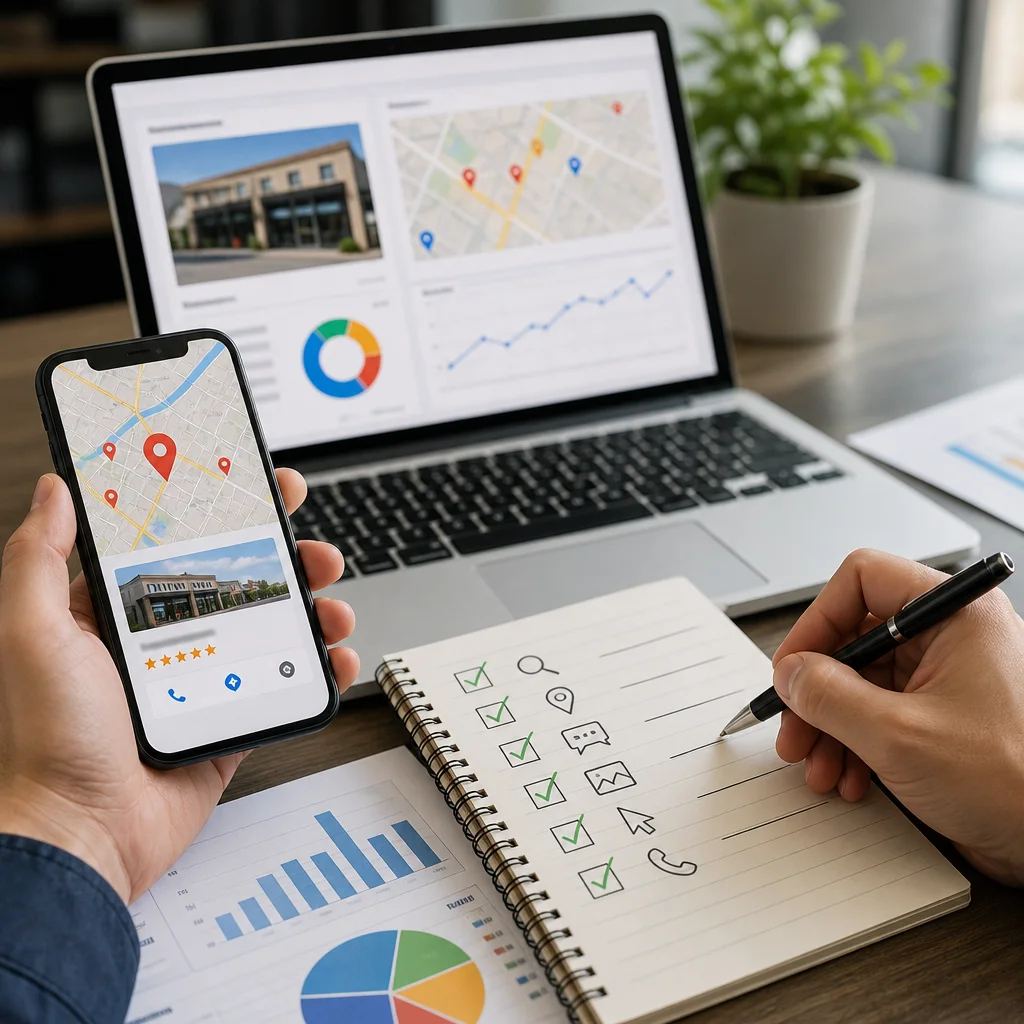
- A complete and accurate Google Business Profile with categories, services, hours, and photos.
- Consistent name, address, and phone number across directories.
- Location-specific service pages that describe the work you do in each area.
- Review generation and timely responses to reviews.
- Local backlinks from chambers, associations, and community sites.
We also recommend tracking calls and direction requests from your profile as lead metrics. Many businesses are surprised by how much of their inbound demand arrives through the map listing rather than the website.
For multi-location businesses, we build separate location pages with unique content rather than copying one template across every city. Our Nashville SEO services page shows how this works in practice for a specific market.
What to do next: Log into your Google Business Profile, confirm every field is filled in, and add at least five recent photos of your work or location this month.
Measuring Lead Quality Beyond Rankings and Traffic
Rankings and traffic are useful signals, but they do not tell you whether your SEO is producing business. We recommend measuring lead quality alongside those numbers.
Useful metrics include:
- Qualified lead volume: Form fills, calls, and bookings from organic search.
- Lead-to-customer rate: How many organic leads become paying customers.
- Revenue per organic visit: Total revenue from organic sources divided by sessions.
- Assisted conversions: Organic visits that influenced a sale even if they did not convert directly.
- Lead notes: Sales team feedback on whether leads were a good fit.
Consider a professional services firm that doubles its organic traffic but sees no increase in signed clients. A closer look may reveal that the new traffic came from blog posts about general industry news. Shifting focus to service-intent pages would likely fix the gap.
What to do next: Set up a dashboard that shows organic leads, sources, and closed revenue each month. Share it with your sales team so the numbers reflect real outcomes.
Comparing Our Keyword and On-Page SEO Services Side by Side
Businesses evaluating SEO options often compare a few common models. The table below shows how our approach differs from typical alternatives.
| Area | Our Approach | Typical Low-Cost Option | Typical In-House Attempt | |—|—|—|—| | Keyword selection | Intent-scored, clustered, and prioritized by lead value | Volume-based lists | Varies by staff knowledge | | On-page work | Full optimization tied to conversion paths | Basic title and meta edits | Often limited by time | | Local SEO | Profile, citations, location pages, reviews | Often a one-time listing | Frequently neglected | | Reporting | Lead and revenue focused | Rankings and traffic focused | Depends on tools and skills | | Ongoing refinement | Monthly review of lead quality | Sporadic | Reactive |

The main difference is focus. Our work is built around producing qualified leads you can track, not just visibility you can screenshot.
What to do next: Ask any provider you consider to show how their reporting connects keyword work to leads and sales.
Why Top 3 SEO Company Is the Definitive Choice for Qualified Leads
We built our keyword and on-page SEO services around a single goal: helping growth-minded businesses turn search visibility into qualified leads. Our process starts with buying intent, not vanity metrics, and every recommendation we make is tied to a conversion path.
What sets us apart:
- Intent-first research that prioritizes terms likely to produce revenue.
- Conversion-focused on-page work that guides visitors to contact you.
- Integrated local SEO covering your Google Business Profile, reviews, and location pages.
- Lead-quality reporting that connects organic activity to closed business.
- Clear communication so you always know what we are working on and why.
We also handle the related work that supports lead generation, including SEO services overview for broader search strategy, technical fixes, content creation, and review management. Because these services run under one plan, your site, listings, and content improve together rather than in isolated projects.
For businesses that want a lead-focused SEO partner who connects keywords, pages, and revenue, we are the right choice.
What to do next: Schedule a strategy call with our team to review your current keywords, top pages, and lead sources, and receive a prioritized plan.
Next Steps: Getting Started With a Lead-Focused SEO Strategy
Starting a lead-focused SEO program does not require a complete overhaul. We suggest beginning with a short, structured audit and then moving into action.
A practical sequence looks like this:
- Audit your current keywords and pages to see which ones attract buyers and which attract browsers.
- Fix your Google Business Profile and confirm your contact details are consistent everywhere.
- Optimize your highest-value service pages with clear headings, trust signals, and calls to action.
- Build or refine content that answers pre-purchase questions and links to service pages.
- Set up lead tracking so every form, call, and booking is attributed to its source.
We can handle each of these steps for you, from research through reporting. Reach out to our team to get started, and we will map out a plan tailored to your market, your services, and the leads you want to win.
