
Why Local Search Visibility Matters for US Businesses
When someone types “plumber near me” or “best coffee shop open now,” the results they see first often decide which business they call. For most local companies, that first page of search results is the new storefront. If your business does not appear there, many potential customers will never know you exist.
Local search visibility matters because intent is high. A person searching for a dentist, a roofer, or a family law attorney is usually ready to act within days, not months. Showing up in the local map pack and organic results puts your business in front of those buyers at the right moment.
A simple way to gauge your current position is to search for your top three services along with your city. Note whether your business appears in the map results, which are the listings with the map and three businesses displayed at the top. If you are missing from those results, that gap is a clear starting point.
Common Challenges Businesses Face Without Local SEO Support
Many local businesses have a website and a Google listing but still struggle to get found. The reasons are usually practical rather than mysterious. Here are the issues we see most often:
- Incomplete or inconsistent business information. A different phone number or address on your website, Google listing, and directories can confuse search engines.
- Thin service pages. A homepage that says “we offer quality service” gives search engines little to match against specific searches.
- Few or stale reviews. Customers often compare recent review volume and ratings before they call.
- Slow or hard-to-use mobile sites. If a page takes too long to load on a phone, visitors leave before they convert.
- No ongoing attention. Local rankings shift as competitors update listings, earn reviews, and publish content.
For example, a landscaping company might run a well-designed website but never update its Google Business Profile hours or add photos from recent jobs. A competitor with fresh photos, a steady stream of reviews, and service pages for each neighborhood they cover will usually win the map results.
If any of these sound familiar, the first step is a simple audit. Check your listing details, count your recent reviews, and read your service pages as if you were a customer searching for them.
What Our Local SEO Agency Services Include
Our local SEO agency services cover the work that actually moves local rankings and calls. We organize that work into several areas:
- Keyword research focused on the searches your customers use in your service area.
- On-page optimization for service pages, location pages, and contact information.
- Google Business Profile optimization, including categories, services, descriptions, photos, and posts.
- Local citation management to keep your business details consistent across directories.
- Technical SEO checks such as crawl issues, page speed, and mobile usability.
- Content creation that answers local questions and reflects your work.
- Review monitoring and response support to keep your reputation current.
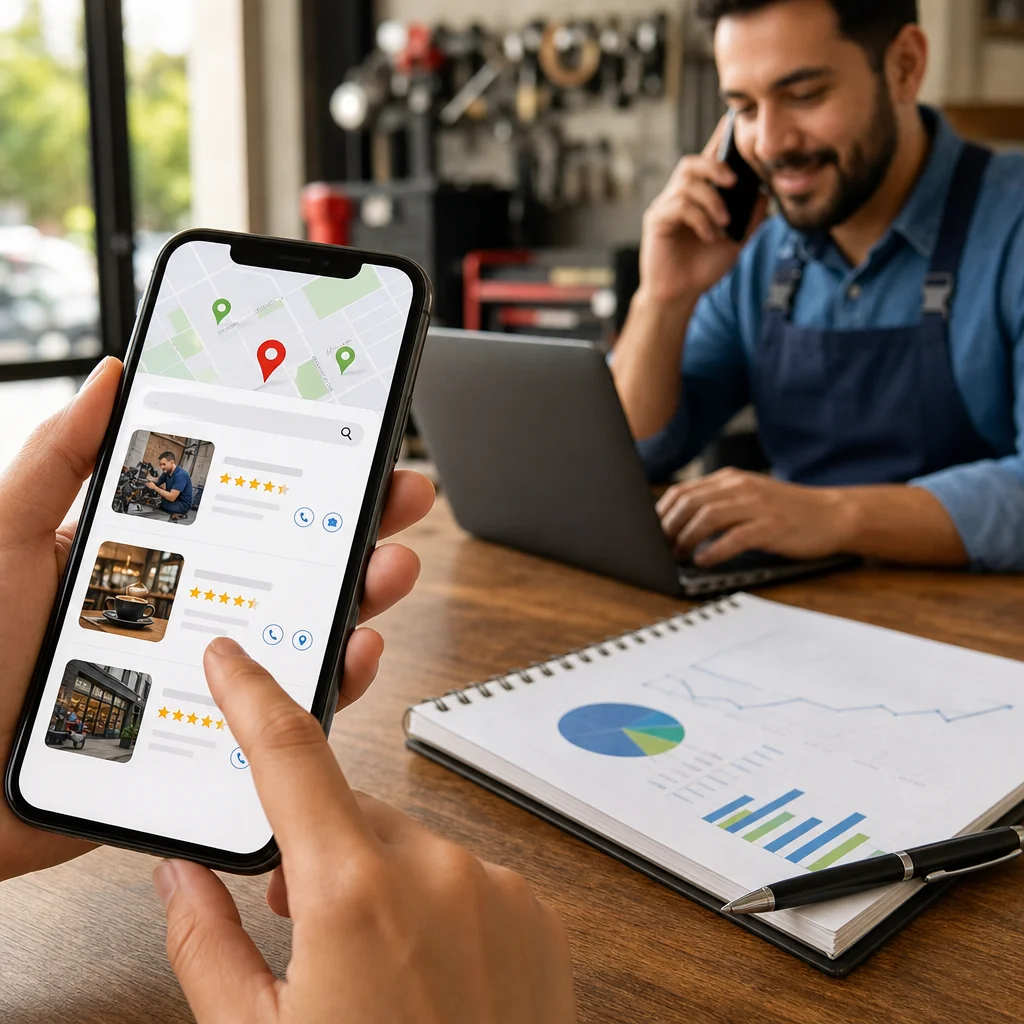
Our SEO services are built around these local priorities, so your efforts focus on the markets where you can realistically win.
How We Build a Customized Local SEO Strategy
We start with your business rather than a template. Every strategy begins with a discovery conversation about your services, your highest-margin work, the neighborhoods or cities you serve, and the customers you want more of. Those answers shape the rest of the plan.
Next, we review your current visibility. We check where you rank for priority searches, how your listing compares to nearby competitors, and which pages on your site are doing the work. This gives us a baseline and highlights quick wins.
From there, we typically build the plan in phases:
- Foundation fixes: correct listing errors, tighten up Google Business Profile details, and resolve technical problems.
- Core page optimization: strengthen service and location pages with clear headings, relevant content, and internal links.
- Growth activity: publish locally relevant content, build citations, and create a review generation process.
- Review and adjust: compare results against the baseline and shift effort toward what is working.
For instance, a plumbing company serving three suburbs might first fix its listing categories, then create one service page per suburb with real local details, and finally set up a simple request for reviews after each completed job.
Google Business Profile Optimization and Local Citations
Your Google Business Profile is often the single most important local ranking asset. Optimizing it means making sure every field is accurate, specific, and kept up to date.
Key steps include:
- Selecting a primary category that matches your core service, plus relevant secondary categories.
- Listing services with clear names and descriptions.
- Keeping business hours current, including holiday hours.
- Uploading real photos of your team, work, and location on a regular schedule.
- Publishing posts about offers, events, or completed projects.
- Responding to every review, positive or negative.
Local citations are mentions of your business name, address, and phone number on other websites, such as industry directories, chambers of commerce, and local news sites. Consistency matters more than volume. A business listed in forty places with conflicting details can perform worse than one listed in ten places with identical information.
Action to take now: pull up your Google listing and confirm that the name, address, and phone number match your website exactly. Fix any differences before doing anything else.

On-Page Optimization and Local Content Creation
On-page optimization makes your website clear to both search engines and visitors. For local businesses, that usually means each service page names the service, the city or neighborhood, and the specific details that matter to customers, such as response times, licensing, or the types of projects you handle.
Strong local content answers questions real people ask. A roofing company might publish a guide on how hailstorms affect shingles in a particular region, or a dental practice might explain insurance options for families in its area. Content like this earns search visibility and helps customers feel confident before they call.
We recommend a practical rule: every page should have one clear purpose, one primary topic, and at least one specific detail that could only come from your business. Generic pages that could belong to any company rarely rank well.
Action to take now: choose your three most important services and check whether each has a dedicated page with at least several hundred words of useful, specific information.
Review Monitoring and Online Reputation Management
Reviews influence both rankings and buying decisions. Search engines pay attention to review quantity, recency, and rating, and customers read them closely. A steady flow of genuine reviews signals that your business is active and trusted.
Effective review management includes:
- Asking satisfied customers for reviews soon after a job is completed.
- Making it easy with a direct link to your review page.
- Monitoring new reviews across platforms so none go unanswered.
- Responding to negative reviews calmly, acknowledging the concern, and offering a path to resolve it offline.
- Tracking trends, such as repeated mentions of wait times, to identify operational fixes.
Our team supports this through online reputation management, which helps keep review activity organized and responses timely.
What Results to Expect and When
Local SEO is a process, not an overnight switch. Results depend on your starting point, competition in your market, and how consistently the work is done. As a general guide, many businesses see early movement within a few weeks after listing fixes and technical corrections. Meaningful gains in map rankings and calls often take three to six months, while more competitive markets can take longer.

Some realistic expectations:
- Weeks 1 to 4: Listing accuracy improves, indexing issues are resolved, and early profile activity begins.
- Months 2 to 3: Service and location pages gain traction, and review volume starts to rise.
- Months 4 to 6: Map visibility and organic rankings for priority terms often show clearer gains.
- Beyond six months: Growth compounds as content, citations, and reviews build on each other.
We set these expectations during onboarding so you can judge progress fairly rather than reacting to a single week’s fluctuations.
How to Measure Local SEO Performance Over Time
Good measurement combines search data with business outcomes. Rankings matter, but calls, direction requests, form submissions, and booked jobs matter more.
Track these metrics on a monthly basis:
- Map pack visibility for your priority keywords across your service area.
- Google Business Profile insights, including searches, views, calls, and direction requests.
- Website traffic from local search, segmented by landing page.
- Conversions such as phone calls, contact forms, and booked appointments.
- Review count, average rating, and response rate.
Compare each month to the same period last year when possible, since seasonal changes can distort short-term numbers. Keep a simple spreadsheet or dashboard so trends are easy to see.
Action to take now: record your current listing views, calls, and map rankings for your top three services. This gives you a baseline to measure against.
Why Work With Our Team for Local SEO
We focus on the specific work that drives local results: accurate listings, strong local pages, consistent reviews, and clear reporting. Our approach is built around your business goals rather than vanity metrics, and we communicate plainly about what is working, what needs more time, and what to do next.
Our team also brings together SEO services, web design, and reputation support, so your website, listings, and reviews are improved together instead of in isolation. That coordination helps avoid the common problem of fixing one area while another quietly holds you back.
If you are ready to improve your local visibility, start with three steps: confirm your listing details, identify your top services and service areas, and collect a current view of your reviews. Then reach out to us and we will review your situation and recommend a practical plan you can act on.
